On June 4, 2019, more than 30 speakers, most of them living near the pond, filled more than an hour of a Bedford Town Board meeting talking about Todd's Pond. According to The Katonah-Lewisboro Times, they remembered picnics, fishing and ice skating, and the Board responded by forming the Todd's Pond Advisory Committee.
Seven years later, that conversation has produced a proposal. It costs much less than anything put forward before, and it would look rough for a while. The Town has a bid in hand for a limited dredge of one section of the pond. The savings come from drying the excavated muck beside the water and spreading it there, so it never has to be trucked away. If the contract goes ahead on the schedule the Town has laid out, neighbors along Lakeside Drive would see the work this winter and the open water after that.
Five inches of water over eight feet of silt
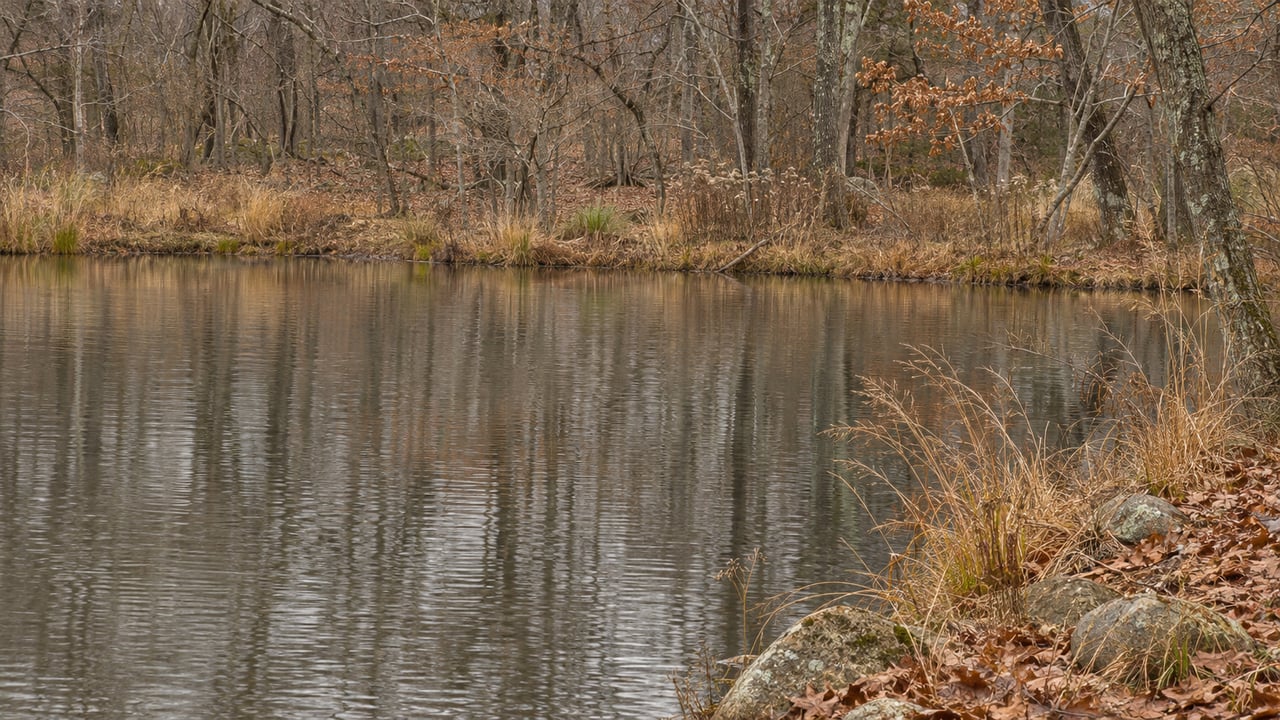
Todd's Pond is not a natural feature. A 2020 study prepared for the Town of Bedford says the pond was dug in the early 1900s for ice harvesting, before electric refrigeration was common. Afterward it was used for ice skating, fishing and boating.
The same study puts the original depth at about eight feet. A 2015 engineering survey found an average of only five inches of water, with roughly eight feet of silt underneath. In many spots the pond had become too shallow to canoe across. The Town's October 2026 notice describes a pond slowly turning into a marsh as sediment builds up and excess nutrients feed plant and algae growth.
Ownership also shaped the debate. According to a 2024 report in The Mt. Kisco-Bedford Times, a Katonah homeowners' organization sold the pond to the Town for $10 in 1997. In the same story, Lou Sorrell, who chaired the committee, recalled a time when "you could skate on the pond."
Why the Town priced a partial dredge instead
Earlier restoration proposals ran into the millions of dollars. The Town's own notice calls that level of spending "not financially realistic." Supervisor Ellen Calves was just as plain in October. "We aren't going to dredge the whole pond [because] that's prohibitively expensive," she told The Katonah-Lewisboro Times. She described the goal as going down "just deep enough to see some water."
She called the advisory committee's approach a compromise, telling the same paper that "it's not a full dredge, it's not a full restoration of the pond. But it brings back some of the things that people want, and at a price that's more reasonable."
The Town's October 28 notice put the proposal at about $300,000 for limited dredging in selected areas. The aim is a better-looking pond and space for passive recreation such as fishing and picnicking. Bidding contractors met residents on the shoreline along Lakeside Drive on November 2 to walk through the scope.
The mud stays, and that is where the savings come from
When sealed bids opened on September 30, 2026, there was just one, from New England Aquatic Services LLC. An October 30 memo from DPW Commissioner Kevin Winn and Parks and Recreation Superintendent Chris Soi says the bid came in within the expected project cost. It describes the contractor as equipped for hydraulic dredging.
The bid itself shows where the money goes. Mobilization was priced at $0. Every further 1,000 cubic yards cost $90,000 if hauled to the Town's compost facility, or $74,000 if stockpiled for someone else to haul. The contractor then offered an alternate that skips trucking entirely and spreads all the material on site:
| Piece of the alternate | Volume | Price |
|---|---|---|
| Base dredge, spread on site | 1,400 cubic yards | $112,000 |
| Additional dredge, spread on site | 2,100 cubic yards | $157,500 |
| Total | 3,500 cubic yards | $269,500 |
The extra 2,100 yards work out to $75,000 per 1,000 cubic yards. At the bid's hauling rate of $90,000 per 1,000, the same volume would have cost $189,000, which is $31,500 more. The memo calls the alternate "more cost effective than the original bid." Calves had already named trucking as "a huge part of the expense" in earlier remediation plans.
The bid sheet estimated the pond's first segment at about 5,444 cubic yards in total. The alternate would remove 3,500 of those, around two-thirds of that one segment, focused next to the Lakeside Drive meadow. The memo recommends paying for it from existing Todd's Pond capital projects. The memo recommends the award subject to receipt of insurance documentation, and the request to award was on the Town Board's November 4 agenda under New Business.
What Lakeside Drive looks like between now and spring
The pond sits just west of Cherry Street at Lakeside Drive. Since the cheaper method keeps the sediment on site, the banks would carry the work for months. The memo's planned schedule runs like this:
- Clearing. Trees and brush would come out along a 400-foot stretch next to the Lakeside and Elm intersection to make space for drying and spreading the sediment.
- December 2026 and January 2027. Hydraulic dredging of the section beside the Lakeside Drive meadow.
- About four months of drying. The dredged material dries on site before it is moved.
- Spring 2027. The dried material is spread over the areas marked on the Town's drawing and seeded.
Calves has said openly that the approach has a visual cost. "Some trees will be lost," she told The Katonah-Lewisboro Times, and "the cattails that are growing up all around the edge will have to come out." If the work runs on that schedule, a walk along Lakeside Drive between the holidays and early spring would pass bare ground, equipment and drying sediment where the cattails stood, with seeding planned for spring.
What the open water is for
The Town has framed the result in modest terms from the start. In October, Calves said that once the money is spent:
"there'll be some open water [and] we'll need to figure out some landscaping along there, so that once again it's a nice place to sit and fish and be near the water."
She said that to The Katonah-Lewisboro Times.
She also told the paper that some residents remember the pond at its old six- and eight-foot depths and want it "restored to perfection." The 3,500-yard plan doesn't attempt that. The Town's notice describes it as a middle ground between a multimillion-dollar restoration and doing nothing while the pond keeps filling in. The proposal targets one stretch beside the Lakeside Drive meadow, deep enough for open water again, with fishing and picnicking named as the uses.
The planned work falls in the quiet part of Katonah's calendar, once the fall weekends in the hamlet's parking lots are over. The Town of Bedford's news page carries Todd's Pond notices for anyone following the Board's decision and the start date. For more on the hamlet itself, see our Katonah neighborhood guide.
At Aurora Banaszek, we follow local projects like Todd's Pond, the kind that change how a Katonah street looks and feels from season to season. If you live near Lakeside Drive and want to know how changes in your neighborhood affect your home, schedule a white‑glove consultation and we'll talk it through with you.